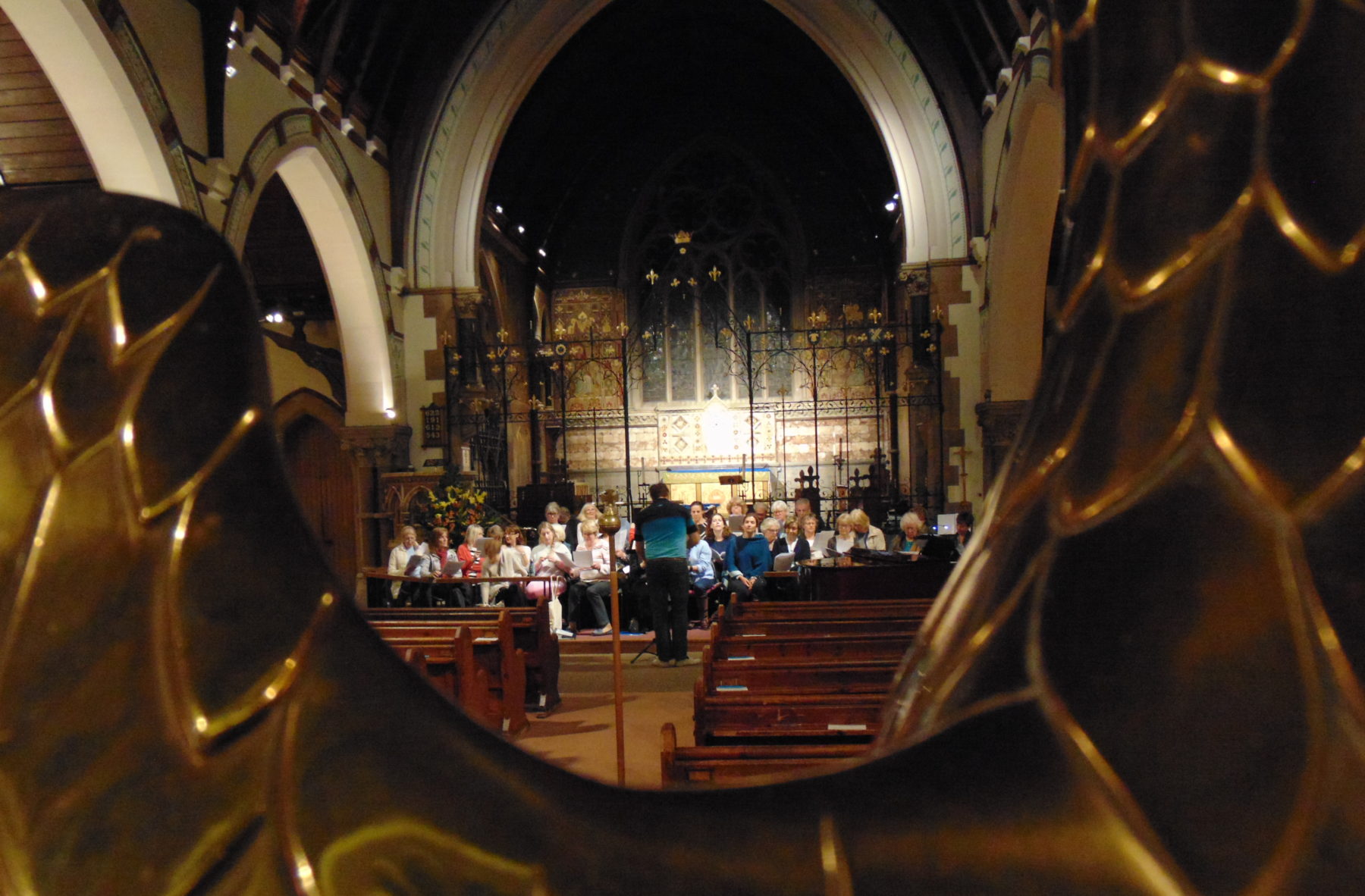
Sorry for the very late review – been a hectic week. First, a big thank you to those who arrived early on Tuesday and laid out the chairs so we were able to start promptly. Please use that same seat location for the rest of the rehearsals and the concert. If you were unable to be there on Tuesday, please sit where directed by those who were there. Everyone has a seat, I promise!
We ran through all of the movements of the Haydn, the Brahms, both Spanish pieces and the Mozart. The only one we didn’t sing was the encore, Va Pensiero. We tried to take into account the feedback Stephen has given us. He will be here in person on Tuesday next.
The work from here can be summarised in two words: dynamics and precision. You have done a brilliant job of learning the notes and the words. Much of what you are doing sounds wonderful.
In terms of dynamics, we are at the moment, as we often are, much too mezzo – mezzo. Everything needs to be far more varied. Think of your voice as having 8 distinct volume levels:
| Marking | Volume level | |
| ppp | 1 | Quietest |
| pp | 2 | |
| p | 3 | |
| mp | 4 | |
| mf | 5 | |
| f | 6 | |
| ff | 7 | |
| fff | 8 | Loudest |
We spend too much time in the 4-5 range. We need to be using all of 2-7, and occasionally adding the 1 and 8 for extreme drama.
We are better at pushing up from 5 to 6 or 7. Less good at going down in volume. And Stephen is looking for much more quiet singing in movements like Im Anfang (emerging from nothing) and ‘Und eine neue Welt.’
Precision means word endings as we have worked, not just the first time it comes in a movement but every time; we tend to lose focus and precision as a piece goes on. It means being bang on the beat with entries, especially quiet ones where our voices take a split second longer to produce a sound and we come in behind the beat on ‘Dich beten Erd’ and ‘in Ewigkeit’ (pp134-135 for example). It means being perfectly in time with the whole choir in moments where everyone is on the same rhythm, such as ‘otra vez’ and many other places in Habanera. And it means loads of other things too. The concert is a big one. You should expect to be physically tired at the end from the exertion of singing. But you should also be mentally tired from the constant concentration that precise singing needs.
Which is not to say that you are not singing very well already. If we performed everything as we did on Tuesday, it would be a very good concert. But I for one would love to make it an outstanding concert, and for that we just need to lift the details a couple of notches.
In two weeks from now we will be assembing at Christ Church with orchestra and soloists and conductor, getting ready for the concert. Not long to go, keep up the excellent effort, and see you all on Tuesday, ready for a prompt 7.45pm start please.
Enjoy the sunshine!
CH
Practice Pack
Work on singing to 8 different volume levels, where 1 is as quiet as you can sing and be in control of your pitch, and 8 is as loud as you can, without losing tone. If the neighbours bang on the walls you are doing it right. Work especially on singing at 2 or 3 on the scale, but ensuring your voice makes a noise right on the intended beat, not just after it. And pay close attention to pitch at lower volumes; it’s super easy to drift flat.
Then work on any piece in the program, but using the full range of volumes, especially the quieter ones. The Brahms especially is nothing without the full range of dynamics and drama.
The recording that Stephen is basing our performance around is this one: https://open.spotify.com/playlist/2oWkBkmDmF5oxggrbmao9l?si=9bb8bbba5fd44648
It would be great for everyone to use this as their singalong tracks from here on so we all have a sense of how the movements flow. Remember that we are not singing every movement, however. The listing is as on the website.